

Lianhe Zaobao: Focus on Integration, do not exaggerate to alarm the public
I refer to the opinion piece by Zaobao Special Correspondent Giam Meng Tuck dated 5 Mar 2023. In responding to my Parliamentary proposal of an English test for PRs and new citizens, Mr Giam’s article, in my view, does not address the importance of integration in multi-racial Singapore for today and the future. Instead, he misrepresented my proposal as equivalent to a test of loyalty to Singapore. This is regrettable.
Mr Giam purposely portrays the false equivalence of an English test and a person’s loyalty to Singapore. Neither I nor anyone who supports an English requirement for PRs and new citizens has made the argument that a language requirement is a proxy for loyalty.
At the outset, let me state the purpose and benefits of an English requirement for PRs and new citizens. A common language plays a critical role in building and strengthening bonds between multi-racial and multi-cultural communities in Singapore today. Strong inter-community bonds have a positive consequential impact on our sense of national unity as a country.
Secondly, there are practical benefits as PRs and new citizens will not find much difficulties in their day-to-day social interactions with Singaporeans, no matter what the setting.
Thirdly, knowledge of English improves employment opportunities.
An English test is also not a novel or unusual requirement in the Singapore context. In the past, the Ministry of Manpower had a compulsory requirement for new foreign domestic workers to undertake an English test. This has since been replaced by a broader one-day Settling-in-Programme.
Finally, it is common sense that it would be advantageous for any immigrant to know the working and common language of the country they have chosen to migrate to. In view of these factors, what is so wrong about having English knowledge as one of the criteria/requirements for new PR and new citizens?
I will now clarify the main points raised in the article by Mr Giam.
Firstly, Mr Giam makes a mischievous connection between locals who do not speak English and the requirement of an English test for PRs and new citizens. These are two distinct and separate issues. It is not unusual to find that our Pioneer and Merdeka generation citizens can communicate effectively even without formal knowledge of English as they have knowledge of Malay language. This access to a common language served to integrate Singaporeans and Malaysians of their generation. The importance of a common language of communication cannot be underestimated in bringing people together. However, I acknowledge that it is but one of many factors that contributes towards integration.
Secondly, Mr Giam says that the older generation of Chinese Singaporeans received Chinese education. He says that although their number is decreasing and their English ability is limited, this does not mean that they are not “Singaporean” enough. This is a misplaced argument as Mr Giam accepts, and I agree that an ability in English is not synonymous with loyalty to the country.
Thirdly, Mr Giam claims that an English test would mean that Singapore does not welcome immigrants to bring their spouses to Singapore. This claim is misleading. There is specific criteria to first meet (not an English test) before one can even apply for Singapore PR or citizenship. Hence, upon closer analysis, perhaps Mr Giam conveniently take an English test as the only requirement for the approval of PR and citizenship, and there are no other qualifying criteria. This is incorrect. Moreover, it is strange that Mr Giam himself at the same time quoted the explanation of the minister that, “ there are other requirements such as income, age, whether someone was educated locally, military service, etc. when a citizenship application is assessed.” An English test would be one more criteria that would in fact, open more doors to new citizens, including the foreign spouses of citizens who may have job opportunities if these foreign spouses choose to join the workforce with an understanding of the working language of Singapore, English.
Thus, an English requirement also goes beyond integration. It can also contribute to the manpower needs of Singapore too.
Fourthly, Mr Giam is correct that there are applicants from countries such as the Philippines and India who would have a natural advantage as English is a popular second language in such countries. However, this again assumes that English would be the only factor relevant for PR or citizenship applicants, which I never called for. Let me repeat my clarification again here, the existing requirements would continue to be relevant. For example, a Filipino or Indian applicant for citizenship who has not done national service or was not educated locally, will have far less advantage with regard to his PR or citizenship application, even if he or she has a working understanding of English.
Regardless of race, language or religion, all Singaporeans want Singapore to succeed for our current and future generations. Many immigrant societies today face the problem of nativism and a local born-foreign born divide. These potential conflicting forces must not be left alone to fester in the deep end of the society and deteriorate . They have to be managed and moderated. Strong integration between Singaporeans, PRs and new citizens is key to defeating these forces. Singapore is a multiracial, multilingual society, PRs and new citizens who are able to communicate in English is helpful to blend in and would be better integrated into Singapore society and that is fundamental to our unity as a nation. The thrust and purpose of my proposal of an English test is for the purposes of better national integration amongst all races and communities.
To conclude, Singaporeans know we are not an “English Country”. Even English is Singapore’s main language of communication – vernacular languages – be they Mandarin, Malay or Tamil, will continue to remain a central part of the identities of all our respective communities. It is in our collective interest to see these languages thrive and used in official communication, not only for the Pioneer and Merdeka generation of Singaporeans, but for all future generations too. Let’s make no mistake about it!
请聚焦于社会融合 、勿危言耸听!
严孟达先生于3月5日《联合早报·想法》之《毕丹星的建议》一文中,讨论我在国会建议对新永久居民和新公民进行英语测试,但并未探讨社会融合对于现在与未来,身为多元种族的新加坡的重要性。 相反的,他把我的建议曲解为等同于对新加坡忠诚度的考验,令人感到遗憾。
严先生特意将英语测试和一个人对新加坡的忠诚度对等。这是虚假的曲解。事实上,我、以及其他支持要求对永久居民和新公民进行英语测试的人都未曾提出语言测试可以代表忠诚度的观点。
让我一开始就在此清楚说明我建议永久居民和新公民英语测试的目的和好处。新加坡是个多元种族、多元文化的社会,拥有共同的语言对建设与强化一个多元种族、多元文化社区的凝聚力扮演关键的角色。社群间强大的凝聚力对我们国家的团结有积极的影响。
此外,永久居民和新公民也不会在日常生活中,不论在任何场合,与新加坡人交流时面对窘境。
再者,懂得英语更有工作的机会。
英语测试在新加坡来讲并不新颖,也不是罕有的要求。人力部在过去曾经强制要求新的帮佣通过英文考试。现在由包含更广泛的一天课程(Settling-In Programme)取代。
总之,对一个新移民来说,能够使用打算移民过去,那个国家的工作和共同语言就会拥有优势,这是普通常识。在对移民申请,原有的各项要求之外,加多一项英语测试有何不妥?
接下来,让我回应严先生文中的论点。
首先,严先生引用通讯及新闻部长兼内政部长杨莉明的说法,不会说英语的本地人也可以融入本地社会的论点;把建议永久居民和新公民的英语测试联串起来。
明眼人都知道这是两个截然不同的课题, 我们不难发现,许多建国与立国一代的居民,即使没有正式的英语知识也能有效地交流,因为他们通常都能使用简单的马来语。 能够使用共同语言有助于融合这一代的新加坡人和马来西亚人。将人们聚合在一起时,不能低估有共同语言交流的重要性。 当然,这只是促进融合的众多因素之一。
第二,严先生说,“ 老一代华族新加坡人受华文教育居多数,虽然他们人数越来越少,英语能力有限。但这并不表示他们的“新加坡人”色彩不够。“ 我同意英语的能力并不等同于对国家的忠诚。我所提出的建议彻头彻尾就不曾与国家忠诚度或国家的认同感挂钩,何来色彩够不够的问题? 这简直是无中生有。
第三,严先生文中声称,英语测试将意味着新加坡不欢迎申请移民者携带配偶来新加坡。 这种说法具有误导性,因为申请者在“有资格申请”新加坡永久居民或公民权之前,首先要满足英语测试以外的特定标准。 经过仔细分析,也许是严先生轻易的把英语测试变成是批准新永久居民和公民身份的唯一要求,而没有其它的标准。 这并不正确。 诡异的是,严先生在同文中也阐述了部长的说明,“ 新加坡考虑的是社会融合的各种标志,包括申请者是否在本地受教育,是否服过兵役,还有年龄和经济贡献。”
所以,英语测试只是多一项标准,实际上,新加坡公民的外国配偶在成为新公民后懂得新加坡的工作语言英语,更有可能力获得工作的机会。其实,英语测试的建议超越了社会融合, 它还可以为新加坡人力资源的需求做出贡献。
第四,严先生说,“来自英语普及的国家如印度和菲律宾的申请者肯定占优势….。“ 这乍看之下似乎是正确的,因为英语是这些国家流行的第二语言。 然而,这是再次把英语测试错误的当成是批准新永久居民或公民身份唯一的资格标准,这并非我所建议的。让我再重复誊清,在英语测试的建议提案下,现有的审核标准依然保留。 例如,没有服过兵役或没有在本地接受教育的菲律宾或印度公民申请者,即使对英语有一定的知识,永久居民或公民的申请也未必就会有优势。
我相信不论种族、言语或宗教,所有新加坡人都希望为我们今世后代,建立一个美好与成功的新加坡。不过,当今许多移民社会都面临着本土主义,或是本地居民与外国出生居民的鸿沟问题。 我们不能让这些潜伏性的矛盾在社会內层發酵与恶化,必须得到管理和调节。
新加坡人、永久居民和新公民之间的紧密融合是化解这些潜伏性矛盾的关键。 新加坡原本就是一个多元种族、多种语言的社会,永久居民和新公民能用英语交流,能够良好磨合,融入我们的社会,将是我们国家团结的基础。 我建议进行英语测试的主旨和目的就是为了更好地将所有种族和社区融为一体。
总的来说,新加坡人都知道我们不是一个“英语国家”。尽管英语是新加坡的主要的交流语言—本土语言—无论是华语、马来语还是淡米尔语,都仍然是我们新加坡各族群的核心特征。
我们都应该支持本土语言的蓬勃发展,让更多官方通讯与咨询使用本土语言。这不仅是为了我们建国与立国一代,同时也为后代扎根,符合新加坡的集体利益。我们必须对此毫无质疑!
Shin Min: Integration for a stronger Singapore
I refer to the opinion piece by Mr Chan Yang Chong dated 3 March 2023 which was a response to my Parliamentary proposal for an English test for PRs and new citizens. Mr Chan does not deal with the thrust of my proposal – which is to ferment better integration between Singaporeans on the one hand and PRs and new citizens on the other. Even so, I will address Mr Chan’s concerns here.
Firstly, Mr Chan argues that there are still many Pioneer Generation and Merdeka Generation Singaporeans who do not speak English. Unfortunately, this point has no connection to an English test for PRs and new citizens. In fact, had Mr Chan consciously dug into Singapore history, he would be aware that our locals, especially our Pioneer and Merdeka generation citizens, some of whom do not speak a word of English, are usually comfortable in Malay, a language which served to integrate Singaporeans and Malaysians of their generation. A common understanding of the Malay language played a part in engendering Singapore’s famous ‘kampong spirit’. With people from so many different parts of the world wanting to call Singapore home today, a common language will mobilise the prospect of stronger integration between all communities.
Secondly, Mr Chan argues that our seniors, and I assume he is also referring to our dialect-speaking ones, have seen their children grow up and not only master English, but also achieve success in their careers. In making this point, Mr Chan has identified how important a working understanding of English is to achieve success in Singapore. Would we not want all our new PRs and citizens to achieve similar success?
Thirdly, Mr Chan states that our Pioneer generation and Merdeka generation have gradually forgotten the past when they suffered from an insufficient English proficiency in their youth. He also shares that this group of people who have suffered so much and dedicated their youth to Singapore will suffer another hard blow with the requirement of English for PR and new citizenship applicants, and that the unpleasant memories that have been gradually forgotten will reappear. If Mr Chan’s assumptions are correct, I respect and empathize with the Mandarin or dialect-speaking seniors who feel this way. But on this point, I doubt if Mr Chan’s assumption is accurate.
In my humble view, I believe that we should not underestimate the resilience and adaptability of this group of our Mandarin and dialect-speaking seniors. In fact, I have met many of these senior Mandarin or dialect-only Singaporeans over the course of my constituency work as a Member of Parliament (MP) over many years. This generation of Singaporeans are successful in their own life and have made Singapore a successful metropolitan city today. They are also already well integrated to the community, particularly through a shared experience nurtured alongside all Singaporeans over many past decades.
I have experienced their resilience and confidence first hand. In my first term as a MP, I recall a senior grandmother in her early 80s who I met during house visits. She was alone at home, and only spoke to me in Teochew. She took me by the hand and welcomed me into her home in Malay. She knew that as an Indian and a Sikh, I was able to eat pork but was unlikely to eat beef, and requested me to have dinner with her. I cannot be sure why she warmed up to me so quickly. Perhaps she was a Workers’ Party supporter, or simply, a kind person. Whatever it was, our interaction was facilitated by the common language we shared.
To conclude, besides common language, I do hope that we are well integrated into Singapore in other ways as well, such as a shared understanding of our Singapore’s history and values, and by a common humanity.
通过良好的融合,成就一个团结的新加坡
续本人在国会建议通过英语测试遴选永久居民和新公民,曾渊沧先生于2023年3月3日发表了相关评论文章。曾先生文中未说明我建议的出发点和主旨,那就是为国人、永久居民与新公民之间培育更有效的交融。
以下让我逐点回应曾先生。
首先,曾先生文中说“相信仍有不少建国一代及立国一代的英文水平并未能达到毕丹星所建议的考试要求…..”。 这个论点与我建议通过英语测试,作为遴选永久居民和新公民的其中一个标准是风马牛不相及。其实,曾先生如果用心钻研新加坡的历史,应该知晓国人,尤其是一些对英语一窍不通的建国与立国一代,他们大都通晓马来语。马来语是共同语,衔接那一代的国人与马来西亚公民的桥梁。马来语在当代的通用性更为孕育新加坡著名的“甘榜精神”做出贡献。随之新加坡成为各国侨民的首选移民地之一,共同语言可促进各个社群的有效融合。
第二,曾先生说本地乐龄人士的成年子女不但能有效掌控英文的应用,并且事业有成。我想这些乐龄人士也应该包括我们只说方言的社群。曾先生这个论点其实正点出了熟练掌控英语在新加坡成功的重要性。难道我们就不想新加坡所有的永久居民和新公民都同样有成就吗?
第三,曾先生声称“ 建国一代和立国一代….. 已逐渐淡忘年轻时代因为英文水平不够而吃亏的过去….. 向这一群曾经吃尽苦头、为国家奉献青春的人再狠狠地打一拳,使到原本已经逐渐淡忘的不愉快再现…” 。如果曾先生的假设属实,我尊重,也能体恤惯用华语或方言的前辈一代对我的建议所产生的不良反应。话虽如此,但我怀疑曾先生对建国一代和立国一的这种假设是否正确。
以本人拙见,我们不应该低估惯用华语或方言的前辈一代人所拥有的韧性与应变能力。多年以来,我在服务选区时碰过无数的相关群体的成员。这一代的国人在生活中各自有成,并通过自身的成就,造就了新加坡今天的大都会盛世。他们也通过与国人这几十年来的并肩奋斗而与各个社群达到良好的融合。
我有幸亲身体验他们的韧性与自信。还记得,在我首个议员任期内做家访时,遇见了一位八十多岁的独居老奶奶。这位长者试图通过潮州方言与我沟通,并牵起我的手,以马来语招呼我入屋。她知道身为印族锡克教徒的我忌牛肉,但可食用猪肉,她邀请我与她共享晚餐。我并不知道她对我迅速的熟络源自何处,或许她是工人党支持者,是个纯良之人。无论如何,我们能互动因为我们有共同语言可以沟通。
最后,除了共同语言,我希望国人也能够通过其他的方式达至良好的磨合,例如对我国历史与价值观的共同理解,以及对人道主义的共识。
10 March 2023
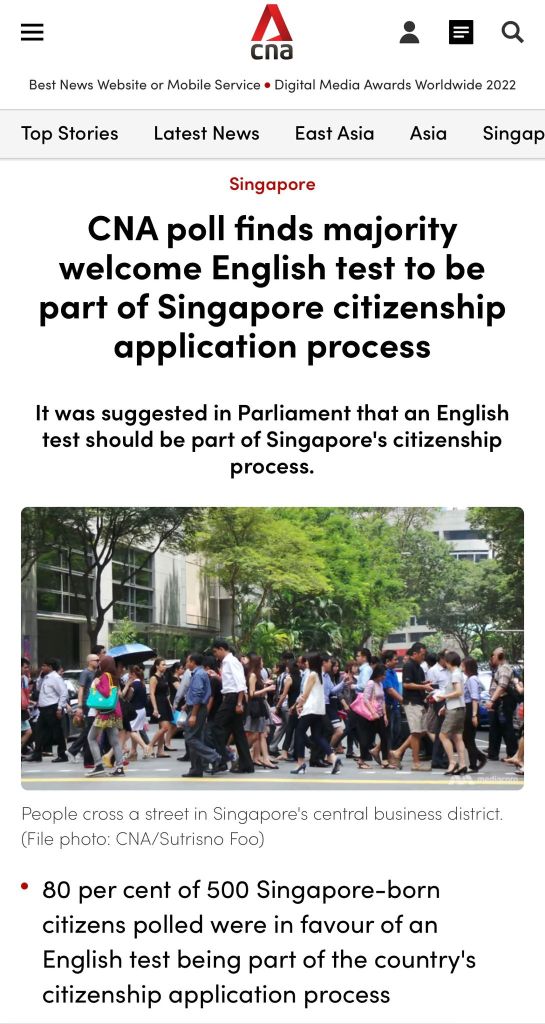
https://www.channelnewsasia.com/singapore/english-test-new-citizens-pr-application-survey-3368571
3 April 2023
 Office of the Leader of the Opposition